Followers

Sunday, 13 October 2024

Are you a senior beginner hiker?


My friends and I rocking this hiking thing.

I cannot begin to describe the trepidation with which I approached this topic.  I have, for several years, had this resistance towards accepting that being on the wrong side of 40 makes you an older hiker in a way. I used to cringe every time I saw exercises for over 40s and so on. I wondered what made them think that just because a person is over 40, they suddenly become fragile and therefore needing special care or special exercises. Isn’t this age thing just a number as they say? And what happened to ‘you are as young or old as you feel’?

The simple answer here is this age business has a way of creeping in gradually and before you know it, what you used to do with ease suddenly becomes a serious mission. Seemingly out of nowhere, standing up or stretching your legs send your joints on some crackling chorus or firecracker show. I started observing these changes in my 40s. I was never a fast hiker and that's probably because I prefer absorbing nature, smelling each moment. I was so fit that there were trails I referred to as quickies. Anyway, some of those 'quickie' trails are now showing me flames, as they say, and I keep gritting my teeth as younger ones whizz past me (it’s been more than a decade since I was in my forties). And it’s beginning to seem like most people on the trail look younger than me; I don’t know if my eyes are also failing me.

I used to look at ‘older’ hikers, especially on backpacking trips, and say, that would be me in a few years. I still want to hike even beyond the age of 70, God willing, and I look forward to that. With all the firecrackers and many other issues raising their ugly heads, I’m still determined to be that grey-haired older citizen on hiking trails for years to come. I may not be able to carry my multiday backpack due to other issues, but if these legs can carry me, I will still be on those hiking trails. I just need to be extra cautious to avoid breaking anything, knowing that they no longer manufacture spare parts for my model. If you do not want to carry a big backpack, there is an option of slackpacking which you can explore to enjoy multiday hikes.


Maybe age is really just a number!


Before I get carried away, this is about you, as a ‘senior’ person wanting to begin hiking and not being sure whether you’ll make it. If you can still walk, you can start hiking. You need to get used to walking and get information on what you need for hiking to make your journey easier. Even if you never experience a multiday or backpacking hike, you will still reap the benefits of hiking.  Please remember that this will be your journey and yours alone. While you may have to hike with other people, don’t be pressured to take longer or more difficult hikes when you’re not ready. Listen to your body and do this hiking thing your body’s way.

Benefits of hiking for seniors

·       Anyone, seniors included, can benefit from any form of exercise, and hiking is a low-impact exercise, making it more suited for seniors.

·       Ageing comes with the risk of osteoporosis and weight-bearing exercises are recommended for the prevention thereof. Hiking is regarded as a weight-bearing exercise, meaning, you will not only be improving your physical health, but your bones will also thank you.

·       Human beings are social beings and since hiking is a social activity, you will not only get to enjoy nature, but you will meet all kinds of people and what a mood booster that is! 

·       Being in the outdoors means more exposure to vitamin D, which our bodies require.

·       Being active reduces the risks of developing old-age issues such as high blood pressure, heart and circulation diseases among others. However, as a precaution, please check with your doctor, especially if you have chronic diseases.


Senior hikers on a break.


Challenges that senior hikers may experience

It would be remiss of me to just paint a rosy picture of hiking as a senior. There will be challenges, with the first one being your fitness level. As indicated above, regular walks can assist you gain the fitness you need to start hiking and to maintain your hiking journey. 

Flexibility

There is nothing like sore and tight muscles to put you off any form of exercise. The elixir for this is regular stretching. Most hikers, regardless of age, seem not to think much of stretching, regardless of the distance they hike. Stretching should be an important part of your life, especially if you exercise. I prefer stretching immediately after a walk or hike and whenever I skimp on that, my muscles and joints become so unhappy. As a senior, you cannot afford not to stretch since you’re dealing with less stretchy ligaments, worn joints such as knees and hips, and possibly your spine too. You can also take yoga and pilates classes to improve your flexibility. You can even stretch when you take breaks on your hike

Balance

As we age, there’s a degree to which our balance can weaken, due to several reasons. Some causes may need medical attention while some may only need exercise. My advice here is to hike with two hiking poles. Not only will these help with balance, they are also a good support for the joints. In addition, they help strengthen your upper body as you walk. Keep your body strong through other forms of exercise too.


And sometimes senior hikers connect with their younger, playful  selves.


Quick tips for seniors


·       Aim to walk as much as you can in between your planned hikes.

·       Don’t carry too much weight, especially as a beginner hiker.

·       Stay hydrated to avoid fatigue and cramps.

·       Do a lot of strength exercises, especially for the legs, back and core. If you don’t go to the gym, let YouTube be your ally.

·       Use hiking poles. Using these is not a sign of weakness or ageing. As indicated above, they have many benefits.

·       As youngsters say, stay in your lane. And this means do you! Hike at a pace that’s comfortable for you. This may mean hooking up with hikers who are not into flying through trails if that's not for you. 

 At the end

Nothing should stop you from beginning your hiking journey, age included. Even if you have health issues, your doctor can give you advice on the best way to start your journey. I am slower than I've ever been in hiking and I try to be careful not to break anything since my model doesn't have spares. And I stop often just to smell the moment and absorb the beauty around me. You can do this! One step at a time!

Did this help? Please post your comment and share this with others so we make the circle bigger!


Td

Monday, 30 September 2024

Staying hydrated when hiking


Hydration bladders are easy to carry, leaving your hands free  

I’m one of those people always carrying a bottle of water and that has got nothing to do with trying to shed some of my load. At least I know that it will take more than gulping litres of water to reduce my weight, so if you’ve seen me with a bottle of water in hand, it’s just me ensuring that I stay hydrated.  I have already shared information on the type of backpack you need when hiking, and the specifications included having outside pockets that can accommodate bottles of water and space for a water bladder. This is important as staying hydrated on a hike is essential for your safety. The heat this season is what prompted this piece. And just as a reminder, even in winter, hydration is still very important.

You’ve probably been told that our bodies are made up of between 50 and 75% water, and because we keep losing it through sweat, urine, and so on, we need to keep replenishing what we lose. And what better way to do that than drinking more water? I know some people may count other beverages they consume and think they’re hydrating. Just because it is liquid, it does not mean that it will hydrate you. In fact, there are beverages that require you to hydrate while consuming them as they are dehydrating.

Electrolytes

I’m now going to sound educated and smart. I have already mentioned that we sweat a lot when hiking. And with this sweat, we’re not only losing water, but we’re also losing electrolytes such as sodium, potassium, calcium, magnesium and others which, according to healthline.com, are essential for maintaining cell function, muscle contractions, fluid balance and general body functioning. If you feel fatigued or experience muscle cramps during a hike, that may be a sign of low electrolytes in your body or dehydration.   

Most sports and health shops sell electrolytes either as sachets with granules or dissoluble tablets. These should always be in your backpack, especially when it’s hot or when you’re on a multiday hike. If you’re using bottles, it may be wise to pop in an electrolyte tablet or sachet in one. Make sure that you get advice when buying electrolytes as they have divergent uses. There are some for pre-exercise to help you stay hydrated for longer and to help with endurance, while others are meant to assist with muscle recovery post-exercise. There are also isotonic drinks and gels which may help with replenishing the lost electrolytes.

Hydration packs

While I have such a healthy relationship with water, I’ve not always consumed enough when hiking. The first issue was when I started hiking, just like the many people I see on trails, I carried water bottles. The difference here is that at least I carried the bottles in my backpack instead of holding them in my hands. Did that help keep me hydrated? You guessed right! Because accessing the bottles was always a mission which required me to stop, undo the backpack and remove it so I can pull out my bottles, this affected the frequency at which I hydrated. Well, you may have the bottles on the outside pockets, but that is never really such a good option as the water gets hot. I suspect those who carry their bottles in their hands experience the same thing. What’s worse with their option is that once the bottle is empty, there’s no longer any motivation to keep carrying it, which leads to littering.

I know many people who hit the trail without even a drop of water, and I try to remind those I hike with of the importance of water when hiking. Some bring water in bottles and because of the inconvenience of having to remove the backpack to access it, they end up not drinking enough. Please note that I’m not selling hydration packs or bladders, but it will be remiss of me not to share the convenience they offer. I know people have asked why I needed a catheter or drip in a hike, and I’ve patiently explained that the catheter is a trusted friend to ensure I stay hydrated throughout my hike.


A hydration hose is easily accessible than a bottle of water in the bag.


I’ve had moments of forgetting to use my hydration bladder even though the hydration hose was just close to my mouth. In 2017, while hiking the Ancascocha trail in Peru and dealing with the altitude that I thought was going to be the end of me, the last thing on my mind was water. Everything was a struggle. A sister friend had to keep reminding me, ‘Moratiwa drink water’, each time I mentioned a headache. Taking that sip of water was a mission, but as soon as I started remembering to take a sip, I had hope that my family will not have to receive my body at the airport. And there were moments where my backpack, with only my water and a few snacks, got so heavy that a porter had to carry it for me. With limited access to water, my body wanted to give in, hence I want to plead with you, if you take anything at all from all my writings, let it be that you never have to be on a hike without enough water, whatever that means for you. Remember, when you hike, especially when it’s hot, you sweat a lot, and you need to put that water back.

Taking frequent water breaks

Taking a break allows the body to cool down.

One habit that hikers develop over time, and I'm one of them, is to hike without frequents stops, especially on day hikes. Believe me I'm not sure how that habit crept it. I sometimes miss the good old days when hiking meant taking frequent stops - okay, maybe I don't miss stopping every ten minutes - just to be present and smell the moment. We've become so used to rushing that we forget that the reason we go hiking is so we can slow down and be one with nature. While a break gives you time to connect with nature, it also allows your body to cool down so you don't sweat too much. It also gives you time to rehydrate and even replace your energy even if it's just with a snack bar or nuts. Talking about snacks, something salty is recommended, especially where you stand to sweat a lot. There will be a time when you finish hiking and your face has white crumbs. If you want, you can taste it, after all the crumbs are from your body. And that's when you know you have to replace electrolytes.

Finally

If more than 50% of your body consists of water, what do you think happens when you lose some of that? Let water be your favourite bev, especially when you hike. That will ensure that you do this one foot in front of the other thing without cramps and fatigue. One sip at a time!


So there are backpacks and then there are hiking backpacks. Huge difference!


Td


Sunday, 8 September 2024

Nature teaches


Nature teaches us that we can rise back from hardships.

On the first Saturday of September, two hiker sisters and I visited one of the trails I count among the toughies in the Gauteng Province - I almost always feel like I’ve been hit by a loaded truck after hiking this trail. This being the spring season this side of the hemisphere, I was reminded of the many lessons we can get from nature. And I know I have shared what I learnt from hiking, but this time I am writing about what I observed regarding how nature works, something that many of us see but maybe do not learn from.

Circle of life

I once had a conversation with a friend about how human beings must learn to accept death as part of being alive. Whether we are going to die young or old is something that is beyond us. And yet we like trying to be in control of that. We see death as an end and not part of the circle of life. And I must say, I have experienced deaths of people close to me and yes, none of them was easy on me. I have learnt that every new beginning is preceded by death. When someone gets married, their single life dies as they begin life as a married person. When a woman gives birth to a baby, her life as she knew it dies, and she begins a new life as a mother. You can think of many other examples, including how your life as a non-hiker died as you birthed your new life as a hiker.


And after losing leaves and standing bare for a few months, the new season has brought back the beauty, which will last for a while only.

As human beings, we spend fortunes trying to preserve our youthful looks and even to prolong our lives, all the while, not living fully as our focus is on the future. When it’s time for leaves to die, they gracefully fall on their own, or as the wind blows and release them from the branches, without resistance. And there on the ground, they make a beautiful carpet of different colours, and they are available to be used by some animals to build their shelters while they also enrich the soil.

Change

Change is an inevitable part of our existence and yet we tend to resist it with all we have. And yet each year we see seasons changing, which confirms that nothing stays forever. And as seasons change, we see nature going through changes too. With the falling leaves mentioned above, trees stand naked while the grass go dry.  And all these plants go through this, only for a new season to come, bringing with it new leaves and flowers or even fruits. And yet as human beings, we are comfortable to have things staying the same or doing something the only way we are used to, thereby not allowing ourselves to grow new leaves and flowers.

While change can happen over time, sometimes it may be instant - the same way that we can wake up to a sunny day only for clouds to form and cause a storm. And when that happens, we need to adapt.

Source: Quotequeendom.com

And change may take a form of no longer enjoying hiking with big groups, not because you’ve lost your love for a particular hiking community, but because you have found what speaks better to your soul. Or like myself, deciding that sleeping in a tent no longer works, either because of another change that makes crawling into a tent difficult, or because of a simple change in preference.

Renewal and new beginnings

People often ask about coming across snakes during hikes. While you may come across a snake, sometimes instead of seeing a snake, you may see the skin it has shed. And that is a beautiful lesson in nature about renewal. I grew up in a village where you’d be greeted by a snake at the door in the morning, or at the outside toilet. They were everywhere, and I feared them. I still have issues with snakes, but I came to embrace what they represent and what they teach us. When it no longer serves you, you can shed it and come out renewed. And if it means taking time off to hibernate for a while as you prepare for your renewal, why not? There are animals that disappear in winter (apparently they sleep throughout the winter season) only to come out in Spring, renewed.


Sometimes for renewal to happen, you may have to go through rough.

I couldn’t help but notice the beautiful plants showing their presence as they rise from the burnt ground - renewed - and each showing off their unique colour and being ready to flourish. I know you’ve already been told that your hardships or what may seem like a raging fire in your life, may be preparing you for something better. I invite you, as you walk through the trails, to observe and listen to nature as she advises you. And each time a beautiful butterfly flutters by, remember the transformation it went through to be that beautiful

Adaptability

During this hike, I couldn’t help but notice the trees at various stages of their lives. Some were bare while others had green shoots or complete leaves; others had beautiful flowers which they showed off. And each of the plants was allowed to be. Do we as humans allow others to just be? Or do we start wondering why she has leaves and I don’t? Why is she having flowers while I don’t? And when circumstances stop the plant from growing taller like others of its species, that doesn't stop it from blooming. You may not achieve what your peers have achieved, but that should not stop you from being who you are, and blossoming where you are just as you are.


No matter where you find yourself, you can still bloom.

Collaboration

I think the biggest collaborators we know are ants and bees. While they work with their own most of the time, bees also collaborate with flowers as they use pollen for their own nutrition while transferring it from one flower to another, assisting with pollination. Plants not only provide us with food, but they also provide same to animals. In the process animals help spread the seeds, thereby leading to reproduction. Trees provide shade for us and provide shade and shelter for animals too. And we know of birds who eat ticks from some mammals. As human beings we can fly further if, like birds, we fly in a group, harnessing the strength we each have. Stronger hikers also support and motivate beginner hikers and those struggling due to one thing or another. Some collaborations in hiking means planning on how to share supplies and other hiking essentials on a hiking trip.

Finally

This was not meant to be a motivational piece. Just me sharing what my weekend hiking brought to the surface. I guess another lesson from the weekend was remembering when to slow down and when to rely on each other. My hiker sister slipped on a slippery descent and injured her ankle. We had to sit with her until she felt ready to try walking. We were less than a kilometre to the end of the trail when that happened. It took us an hour, if not more, to complete that distance because we had to slow down and support one of our own - she is now wearing a moonboot. I wish her a speedy recovery and I know that, having witnessed what nature does, she will nurse herself back to health so we can go back to exploring nature and getting more lessons together. Not all lessons have to involve pain but yes, even in pain, we get taught something. I hope your lessons won’t involve pain, and where they do, that you will be gentle with yourself as you deal with that. And remember to prepare for your hike.

Keep doing!

Td


Saturday, 31 August 2024

Exercise and stretch to enjoy your hikes


We know that marathon runners and other sporting people exercise to keep their bodies in shape. And this does not mean runners only need to run. Each sport requires complete body fitness and all athletes understand the importance thereof. Which is why they incorporate both cardio and strength exercises in their regime.

Hiking not only takes us to places which reward our physical exertion with breathtaking views while at times taking our breath literally, it also allows us to stretch ourselves a bit more with some strenuous hikes which also give us a sense of achievement. However, for one to enjoy such achievement, one must be at a certain level of fitness, which may need you to train a bit more.

I know I have mentioned walking before, and while this can help, there is a bit more you can do. Walking, like running, is necessary for raising your heart rate, which will benefit you a lot on a hike. You probably can relate to the huffing and puffing you experience on ascents, and doing cardio can ease that. Cardio exercises are beneficial for your stamina, fitness and strength, both essential for hiking.

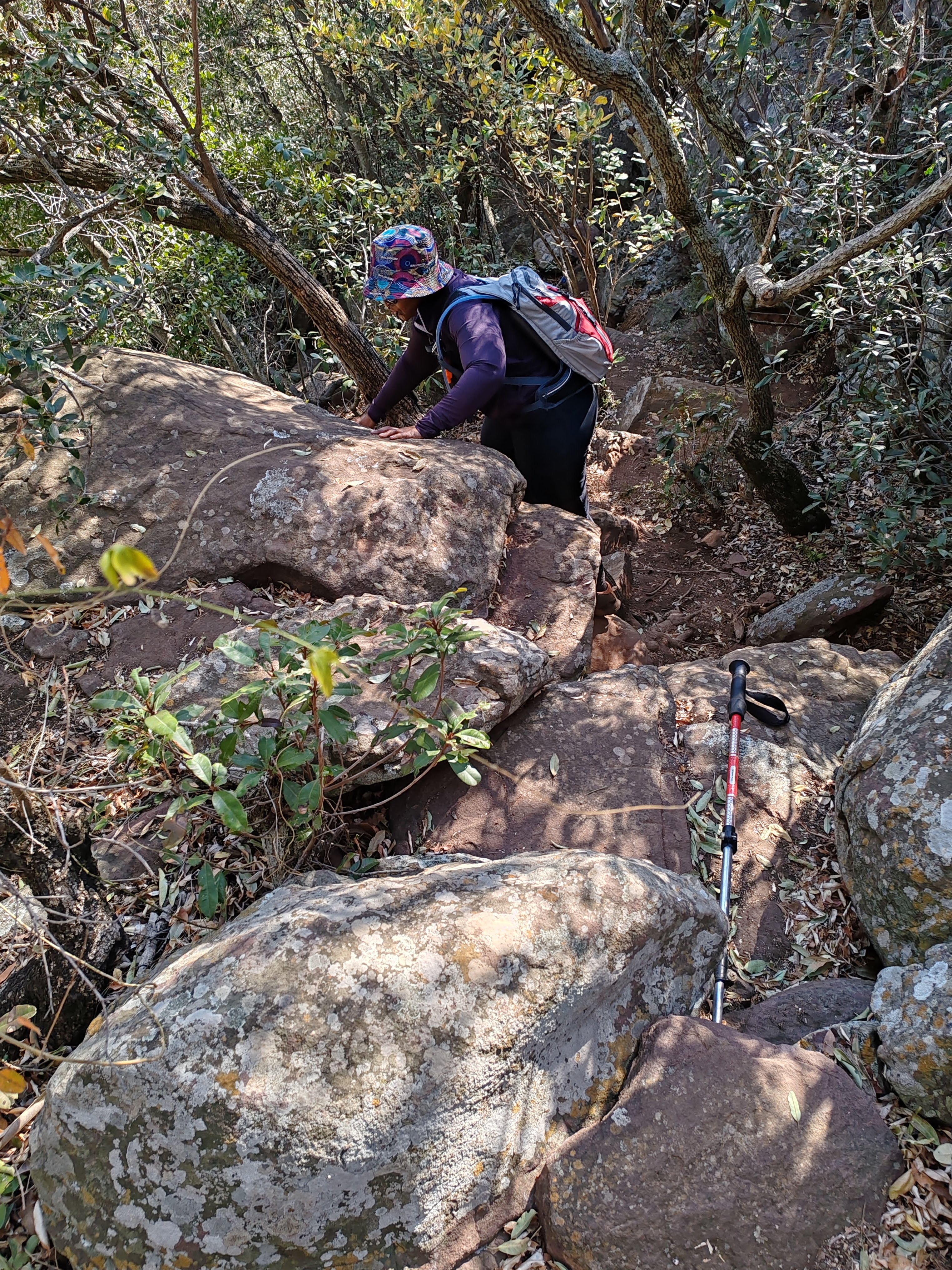
(Hiking requires full body strength - you need strong arms when climbing over boulders. Photo thanks to my newest recruit, Moeder)

Leg strength

In addition to cardio exercise, it is important to do strength exercises. Hiking requires full body strength. Depending on the type of trail, you may need to carry a big bag which requires a strong back, shoulders and even legs. Strong legs are very important as they must carry your whole body, and backpack where applicable. I am a true case study of why leg strength is important.


For the longest time I used to experience leg trembling each time I had to lift myself up on climbs. As my early years of hiking also included being terribly scared of heights, I attributed the trembling legs to my fear of heights. Isn’t it we know  that people tremble when they are scared? I cannot forget the rattle of the chains on the rock face during my climb when I did the Sentinel Peak hike many moons back. I still remember how fast I had to climb as I could feel my legs trembling and fearing the possibility of freezing somewhere in the middle of those chains. A physiotherapist friend mentioned leg weakness and somehow, I brushed that off. I was convinced she didn’t know what she was talking about. I went to gym almost everyday of the week except weekends, which were at times meant for hiking. How could she even think I could have week legs?

 (My trembling legs got those chains rattling. Photo from Drakensberg Hike Newsletter online) 

And for many years thereafter, I fell so many times during hikes that I earned the nickname, ‘Loop-en-val’. It didn’t require much for me to kiss the ground; just losing balance was enough! I even fell at home whenever I tripped or lost balance. It took coming back from a hectic multi-day hike with swollen knees, for me to know that I had weak legs. A hiking buddy referred me to a physiotherapist who could not believe that I hiked with such weak legs. My patience with the recommended leg exercises, coupled with consistency, led to me finally having strong legs and no longer falling at every hike. And yes, that name no longer exists; I don’t even think those who loved me enough to bless me with such a name still remember my falls.

Stretching

The worst thing we do as hikers and generally most people who exercise, is that we seldom stretch or, where we do, we don’t do it enough. Stretching after a hike is important as it helps the body to recuperate. You are likely to experience tired legs, sore muscles, arms (especially if you use poles), glutes, tight hamstrings and so on, after a hike. Check out post-hike stretches that target different parts of your body. Whatever you do, be gentle with your body and don’t do anything that causes you pain.

I promise to get some professionals to help design some leg strength exercises and stretches that I will share with you. I hope you never have to experience being 'loop-en-val' because that affects your hiking. Had I not been already in love with hiking when I started falling, I am sure I would have quit. 

I sincerely hope these posts are assisting you in your hiking journey. If there is any topic or hiking-related subject that you want addressed, please share in the comments. And remember to show some love by following and sharing this and other posts.


Td


Saturday, 24 August 2024

It is not the mountains we conquer…


It is common for hikers to say they have conquered this and that mountain and the saying, ‘it is not the mountain we conquer but ourselves’ by New Zealand mountaineer and explorer, Sir Edmund Hillary - the first man to reach the top of Mt Everest (Wikipedia) - rings true in many ways for me. People often ask why I keep going back when some hikes are so demanding physically and emotionally, and my question to them is whether they quit doing life because it sometimes gets so difficult and demanding. This is often met with suggestions that I cannot compare life to a hike. I’m going to share how I see hiking as a depiction of the journey of life.

Facing your fears

I still remember how I had sworn that the Otter Trail, magnificent as it is (it is in almost every hiker’s bucket list), is one trail I will never attempt. This because of how rough the trail is, plus river crossings and my relationship with bodies of water. Then I hiked the Fish River Canyon where I faced all the fears I had and then some, and I decided it was time to face the mighty Otter Trail. It was to become one amazing hike albeit with its own emotional and physical challenges. Hiking the two trails saw me climbing the real mountains while at the same time dealing with some serious internal work which can be equated to climbing a mountain. And that, in many ways, drove the conquering the self home for me. I had to dig deeper and deeper each day to find the strength to go on at the Fish River Canyon. The Otter Trail has several river crossings, with the Bloukrans River being the one I dreaded the most. What with the stories you hear of people being washed away into sea and one of the tallest guys I know sharing that during their crossing, water came up to his chest. That is way above my head! 

Relying on yourself but knowing when to ask for help

For our group to reach Bloukrans at low tide, we had to start hiking at 4 am to cover the 10 km distance. There was a point I found myself walking alone with other people way ahead and others far behind. I walked for about 5 km alone. It was scary, but I knew I had to do it. And in life, there will be moments where you must do it on your own! Although being independent and self-reliant is necessary, some trails will humble you and teach you to ask for help and trust other people with your life. And you also need to know to extend a hand when someone needs it. Sometimes they may need an actual hand or you may need to share your food or medical supplies; they may also need you to just sit with them as they need to rest.

It is important to know when high tide is expected to avoid such situations. (A heartfelt thank you to the hikers' photographer, Tony Sibanda)

I cannot forget holding on to a man I couldn’t even see (it was dark) during Moshoeshoe Walk in Lesotho. And even with the Otter trail, after the Bloukrans crossing, there is a scary steep climb on a rock ledge. Climbing there was not easy, but having people around me gave me some comfort. And they were patient with me as I had to compose myself and gently plead with my leg to stop trembling so I can climb.

Doing life without expectations

My hope for you, as a beginner hiker, is that you will open yourself to absorbing the life lessons that trails have to offer. That you will allow yourself to be comfortable with not knowing what to expect at the next turn and accept that trails, just like life, have both their ups and downs. That you will accept that there will be times when you’ll think you’ll catch your breath, only to realise there is still an unforgiving uphill beckoning.  That you will be comfortable knowing that you may think that you’ve reached the peak, only  to realise that you still must go down into a valley and that on the other side of that valley, another mountain climb awaits you. That you will be comfortable knowing that you may sometimes need to go off the trail to experience some beautiful views. Sometimes in our life journeys, we must go through unexpected detours, and those may at times bring us the good we never imagined. I hope you will appreciate that you will not always be in control of situations, and that you don’t have to obsess with what you cannot control.


And when you come across a wobbly bridge, you choose how to deal with it.


Perseverance

I am reminded of my moment of denial, in Drakensberg, the day before we reached Mafadi peak - the highest in the country at 3,446 m. It had been a long day, and I was exhausted. I was walking with one lady I share a birthday with, so we call each other twin. As we turned a corner, we heard someone calling from somewhere up a mountain that seemed too high to be reached by anyone, let alone me. I could barely make out who the person was. Given our location, it didn’t make sense that he was one of us. I argued with the lady that the man was probably one of the Lesotho cattle herders and where he was, could be the peak we will be reaching the following day. I could not believe that I still had to climb up a scary gully to reach where he was. I remember saying, ‘there’s no way I’m going there, in fact, I don’t want to go there.’ I can still hear her voice: ‘Shee, Twin! A wa tsenwa (are you mad)? We are going there!’

And indeed, we had to go through that horrible pass, employing every ounce of our mental and physical strength because going back to where we started, was not an option. We reached the escarpment and found that we still had to walk further to the campsite.  A reminder that you don’t give up on your dream of reaching your goals just because it seems impossible; just because the road seems never ending with so many obstacles. And when it feels that your feet can no longer trudge, you don’t give up. You take a rest if necessary, or you just slow down, breathe and take it one step at a time, all the while still listening to your body - something we often neglect in our lives, until the body gives in to dis-ease. And sometimes, all you need do is ask for help.

Not only did I climb up that terrifying terrain, it was waiting for me again on the way down. 

 Being present

I have been asked why I say hiking is healing when it can be so dangerous. That possibility of danger demands your presence and an awareness of your surroundings. Our hectic lives with all the noise and multitasking do not allow for that presence and awareness. We don’t even get to taste and appreciate the food we eat as we just throw it into our mouths mindlessly. When you hike, you follow a trail, which, if you’re not observant, you may lose. You must follow markings as not all the paths will lead you to your destination. A terrain may be slippery, rocky, have grass or exposed roots or even require you to cross a wobbly bridge. All these require your full presence, leaving no space for you to think about your debts, stressful job, relationships or your pending timelines.

Lastly

There are still more life lessons to be taken from hikes, but I will stop here. Just remember, life is like a long hike with winding paths, ups and downs, uneven terrain, storms, rivers to cross, mountains to climb and more. Learning to go through it while breathing and gently putting one foot in front of another, and being grateful for the simple blessings, can make the journey memorable and pleasurable. While we are forced to do a lot ourselves, we also need each other. Be kind to those who need help and grateful to those who assist you.

 At the end of it all, the beautiful views make it all worth going back to, again and again.


Td


Wednesday, 14 August 2024

Slackpacking - my latest poison!


I was so fired up at the thought of writing about my now preferred way of multiday hiking and I remembered a time when I really enjoyed backpacking. I’m not referring to camping as such, as that relationship has forever been complicated. Just carrying that big backpack used to be a source of pride; I loved that I could carry my house on my back over several days. Well, maybe part of the house, considering that some trails offer huts. How can I forget the hike to SA’s highest peak in 2015? I remember after reaching the Mafadi peak, some of the not yet spoken for ladies and gents suggesting that reaching Mafadi would be added to their specifications for eligible courters. I wonder if that still stands.

Most of the hiking destinations offering stunning views accessible only on foot are also not the easiest. Dealing with a heavy backpack and knowing that you must still set up a tent and cook, can be a joy killer. I still have trauma from the Fish River Canyon hike in Namibia. Crawling in and out of the tent was torture, with my knees threatening my prospects of continuing the hike each day. Add to that a fall on my face with that monstrous bag going over my head, and a blue eye as a bonus. I understand the trail has a slackpacking option now, offering a better experience of the largest canyon in Africa and the second largest in the world.


The Fish River Canyon offers awe inspiring views, but it's not an easy hike.


Anyway, I’m excited to share a bit about slackpacking. For those beginner hikers who are still not comfortable with carrying the big backpack and setting up camp, this may be your answer to experiencing multiday hikes. This is an easier way of backpacking, an answer to all the cheese girls and boys out there. While backpacking requires one to carry all their necessities on the back, with slackpacking, all you carry is what you need for the day, while the rest of the stuff is transported to your next destination. Even where there are no huts, your tent will be ferried to the next destination and in some cases, your hosts will set it up for you and you will be greeted with a hot meal and some hot water (albeit rationed) for your bath. That tends to reduce the discomfort that comes with sleeping in a tent – that is if your relationship with tents is anything like mine. 

Uncatered option

The first form is what I mentioned above where there is camping involved. The next form is where hikers move from one hut to another without catering. Here, you may provide your own food, cooking utensils and sleeping bags. While you will hike with only your day backpack, you still need to make your own food on arrival. There is usually a limit on how much you can pack since each hiker may be allocated a container that can only accommodate a specified weight. Make your own research so you pack accordingly.

Catered slackpacking

One of my best hikes must be the one I did in Mpondo, not only for the views, but more for how one got to be immersed in the local Xhosa culture. Picture being hosted by locals in their homes. They avail one house (depending on your number), normally a rondavel, and provide mattresses and blankets. We enjoyed freshly cooked traditional food and the seafood lovers were treated to a bucket of mussels almost every day. Me and my issue with all things shelled! We were treated to entertainment in the form of traditional dance while local crafters sold their wares. I still love the idea. And I owe myself a Coffee Bay hike. It was initially for sentiment, and now it will be in memory of a brother whose transcendence I only learnt of after he was buried – may his soul rest in peace.

And then there's luxury!

Lately there’s hiking destinations that offer hikers luxury on another level where they are accommodated in lodges while bags are transferred daily. Hikers don’t normally care about white sheets and stuff, but I must confess, a hot shower or bath after a hike, followed by a three-course dinner and a proper bed, is not bad at all. Add calamari tasting and a sunset cruise to that and you forget you’re on a multiday hike. This is not something I can do often, but it is a reward of sorts, so treating yourself to one of these occasionally should work. Oh, and this does not come cheap!


This here before a hike is pure bliss!


Advantages of slackpacking

  • Carrying a light weight means you can increase your pace if there’s a need
  • It lightens the impact of a gruelling hike
  • Makes multiday hiking accessible to more people
  • Allows photography enthusiasts to carry their cameras and capture the amazing landscapes
  • And it just makes multiday hiking less cumbersome


And grannies can play as much as they like!

Monday, 29 July 2024

Are you ready for your backpacking hike?


What is backpacking?

You started hiking with easy day hikes and maybe even progressed to longer hikes which required you to extend yourself a bit more. Maybe it’s time to immerse yourself fully in nature where you get to challenge yourself more physically and disconnect completely from your way of doing things. A time to be awed by beautiful sunrises and sunsets, to experience views and places that take your breath literally and figuratively; places reached only on foot. The biggest difference between backpacking and day hikes is that you carry your bedroom, kitchen, and sometimes, your house (tent) on your back.

I started backpacking several years ago, covering some serious mileage in the process, and being enchanted by views that confirm God’s greatness. I think I’ve now earned my retirement! It has been such an enjoyable journey with some of my best memories having been created around the campfire. Damn, the feeling of nostalgia as I write this! Not to say I’m done with multiday hikes. I’m just done carrying all the heavy stuff on my back! I’m being gentle with all my joints, so they continue carrying me for more years. I’ll still write about slackpacking, my now preferred way of doing multiday hikes.


On your first backpacking trip

The basics are similar to your first hike, such as choosing a trail carefully, checking the weather, making sure you have the right gear, food and cooking utensils and safety. I hope to assist you so your first backpacking trip is not overwhelming as you will be organised and confident. And I would advise you to go for an overnight trail that is not too hectic, especially if there are no huts, meaning you must carry your house on your back. This will help you to get used to setting up a tent (a small one please!) before and after a hike and undoing it in the morning before a hike. This while you must cook your own meals. I’d also advise you to start with a weekend hike where you will be hiking for two days only and please, do this with a more experienced hiker. Trying backpacking with another inexperienced hiker may be disastrous. And on your own is a total NO NO! Some trails have guides – at a cost.  As mentioned before here, you’ll fare much better if you can practice setting up your tent at home. And remember the rule on hiking shoes. My advice would be also to take your backpack on a day trail, packed as if you were going on a weekend hike. This will help you check how comfortable you are carrying a big backpack.

Where to go backpacking?

As indicated above, it is always best to start with a weekend trail, and preferably one that’s a bit easy, to ease yourself into the backpacking life and to get used to carrying stuff on your back before attempting rough trails. Starting with a difficult trail may put you off backpacking while an easy trail will give you a chance to enjoy more time at the campsite or enjoying pools, if there are any on the trail. This does not mean there are no rough day trails as some day trails will have you climbing rocks and boulders and crossing rivers.

Where you don’t have an option of nearby trails, do thorough research of the trail you’ve chosen. I cannot overemphasise the importance of research. And this because I’ve been bitten once too many times for not doing my research. I once went straight from my couch to Drakensberg, and to say the trail was not easy would be an understatement. Everything in me was completely shocked, just because I had hiked another part of the berg and thought I knew what to expect!

While all trails can be hiked regardless of the season, some trails are better suited to some seasons, at least according to me. Check this out  for hiking in different seasons in South Africa. Hopefully this will help with choosing your weekend trail.

Transport

It is given that you will need transport to drive to the trail. My advice here is, as you find out about the trail, check out how the road is. Most trails are accessible via gravel road, so be mindful of the car you’ll be using although most of the time, you won’t have to travel a long distance on gravel. Also, most multiday trails in South Africa are circular, meaning you end where you started. I believe this will be the case with your first backpacking trail, meaning you won’t have to worry about your car as it will be waiting for you at the start/end. Where the trail is not circular, meaning you start somewhere and end elsewhere, find out what the transportation options are. Some establishments may offer free transportation while others may require you to book your transportation in advance, and for a fee.

What gear do you need?

I have already covered gear and maybe I should emphasise the importance of packing light. I still struggle with that (read struggled, as I’m done backpacking😄) but the best thing you can do for yourself is to take only what you need. The biggest mistake most of us did when we started backpacking was packing 35 items for a weekend hike, just in case. I was to learn later that I can complete a three-day hike with one set of clothes, this after a guide made us unpack everything we had so we take only what we needed. While packing light, just make sure you have all the essentials lest you’re put off backpacking because you left your sleeping bag, mattress or food. There are hiking checklists to guide you but they are just that, a guide.  Whatever you do, make sure you have these:

v  Tent

v  Self-inflating mattress/sleep pad

v  Sleeping bag

v  Inflatable pillow

v  Stove, pots, plates and cutlery, plus food

v  Head torch and spotlight (optional)

Don’t stress about buying everything as there’s always an option of renting what you don’t have. Yes, friends can lend you some items, but having had one too many bad experiences with that, I’d rather you rent what you don’t have and spare your friendships. The internet is your friend here regarding what is available for rent and the prices. You can also checkout online markets for preloved goods as you may find something there.

Food


When I started backpacking, noodles, tuna, smash and many other not so tasty foodstuffs were the norm. Today the choice is wider, with many shops offering food that either need warming or just adding boiling water to have a delicious meal in minutes. And with the many electronic devices at our disposal, dehydrating your favourite meal shouldn’t be difficult. All you need to do is play around with different food stuffs. Just make sure whatever you do will be clean and safe for consumption. The last thing you need is food poisoning during a hike. If DIY is not your thing, checkout readymade hiking meals or outdoor food online and you’ll me amazed at the options. You will also need some snacks for during the day. And this does not refer to a whole bag of cookies or a big tub of nuts. Get small ziploc plastic bags and pack your snacks in rations (something salty and something sweet). The most important thing here again is water. You must always stay hydrated. Check whether there is drinkable water on the trail and if not, arrange for your own water supply and purifiers.

For your first night, you can enjoy a braai, and leftovers can either be your breakfast or lunch.


Packing your backpack

There’s an art to this and during my backpacking days, some mornings were better than others. However, you need not worry too much as yours will be a weekend hike, so only two days of worrying about your backpack. The trick is to try to fit everything inside the bag, spreading them evenly to balance it. Remember that it’s got to be a perfect size for your structure, specifically your torso, with straps adjusted appropriately. Your tent should be able to fit on the side, held by some straps. You generally start with bulkier items and those not needed until you reach camp, heavy items in the middle and the lightest at the top while those you are likely to need during the day can be stashed in outer pockets. While you can hang other things outside, avoid that as much as possible to maintain the balance.

Straps should be fastened properly as they can easily hook onto trees, and so on, leading to a fall.

Let your first backpacking experience be the first of many adventures. One step at a time!


Td


What hiking keeps teaching me (on and off the trail)

It’s so unbelievable that I haven’t been here since August. I won’t lie; for a while, I felt that familiar pressure creeping in: You’re fa...